

Hobbitmaxxing
Or: an invitation to do things the long way

In April of 2025, I took a little midweek trip to my local thrift store as a treat. I’ve learned that it’s kind of like treasure hunting—you have to check regularly, check thoroughly, be open, and be discerning. On any given thrifting trip, there’s a 25% chance I find something worth buying.
And oh, did I find something this time. A typewriter—1970s, I think—dusty blue, in good shape, and only $20. I took it home. Cleaned it up, bought typewriter ribbon, realized I didn’t know how to change typewriter ribbon, found a manual online… and soon, I was typing.
I had the thing set up at our dining table. Clack-clack-slap. Ding. Whirr. It echoed through the living room, up the stairs, and into the home office. My partner came downstairs to tell me, “God, that’s loud. Our house sounds like a factory from before child labor laws.”
I laughed, and clack-slapped away at the keys; getting faster as I went. The album I was listening to switched to fuzz, so I paused, stood, and walked to flip the record. Set the needle down, sat myself back down—and I wrote a poem.
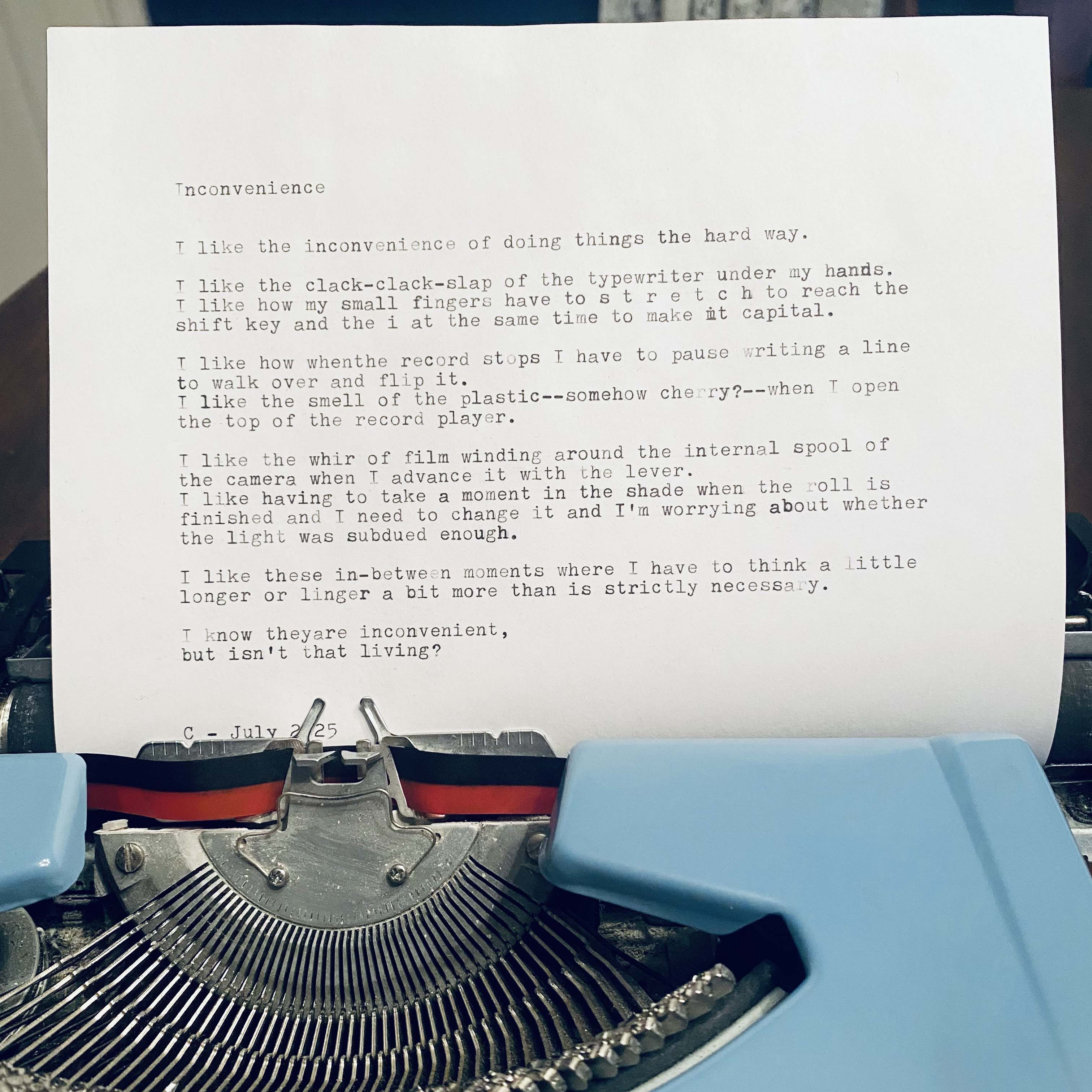
And, I do like inconvenience (despite my frequent complaints over minor ones). I love analog processes. I love the presentness it asks of you. “Be here in the moment with me. Flip your record. Put new paper in your typewriter. Load film into your camera.”
It wasn’t a formal philosophy when I wrote it, but that poem was circling a lifestyle change I’ve been in the midst of making for a while now. I keep choosing the long way around, and other people seem to, too.
Permission to meander
We live in an increasingly digital world. We optimize for speed, scale, frictionless user experiences. Our phones are sleek, our computers are fast, and we have the entirety of the world’s knowledge at our fingertips in a matter of seconds.
And yet, vinyl sales are up. People bake sourdough for fun. Film photography is still kicking.1
And Kurt Vonnegut goes on a walk to buy an envelope, rather than ordering it online.
“’Oh,’ [my wife] says, ‘well, you’re not a poor man. You know, why don’t you go online and buy a hundred envelopes and put them in the closet?’ And so I pretend not to hear her. And go out to get an envelope because I’m going to have a hell of a good time in the process of buying one envelope.
I meet a lot of people. And see some great looking babies. And a fire engine goes by. And I give them the thumbs up. And I’ll ask a woman what kind of dog that is. And, and I don’t know. The moral of the story is—we’re here on Earth to fart around.
And, of course, the computers will do us out of that. And what the computer people don’t realize, or they don’t care, is we’re dancing animals. You know, we love to move around. And it’s like we’re not supposed to dance at all anymore.”
The envelope isn’t the point, I think. It’s permission to meander—and any sort of analog process is the same thing. We can take the optimized path from Point A to Point B as fast as possible; or, we can fart and dance around on our way to the coffee shop. Say hi to some kids on scooters. Touch some moss on a tree. Talk back to the basset hounds that bark at you every day you walk by. Window shop at a little boutique next to the café. Chat with the retiree in line behind you about liege waffles.
I don’t consider it inefficiency. It’s texture; and it’s a helluva lot more flavor to my day than running through a Starbucks drive-through.
And while Vonnegut’s meandering is about process, you can’t talk about analog methods without also talking about aesthetics. Because the “old” or “hard” ways of doing things don’t just slow us down—they show us where the edges of the medium are.
Brian Eno explains it best:
“Whatever you now find weird, ugly, uncomfortable and nasty about a new medium will surely become its signature. CD distortion, the jitteriness of digital video, the crap sound of 8-bit—all of these will be cherished and emulated as soon as they can be avoided. It’s the sound of failure: so much modern art is the sound of things going out of control, of a medium pushing its limits and breaking apart. The distorted guitar sound is the sound of something too loud for the medium supposed to carry it. The blues singer with the cracked voice is the sound of an emotional cry too powerful for the throat that releases it. The excitement of grainy film, of bleached-out black and white, is the excitement of witnessing events too momentous for the medium assigned to record them.”
This impulse to do things the slow way is common enough that people keep doing it. Eno wrote this back in 1995, and it’s funny how accurate it still is, thirty years on.2 Because now, folks are nostalgic for flip phones, shitty 2000s digicams, and the entirety of the pre-iPhone internet.
I like this way of looking at it: failure is a feature, and not a flaw. Grain, crackles, and distortion are tangible evidence of human limits; and analog artifacts are like emotional excess spilling out of the form trying to hold them.
Hobbitmaxxing (a brief explanation)
In 2026, I want to do more meandering.
The concept exists already—slow living—and it’s a focus on values rather than vibes. Local over global, handmade over efficient, ritual over optimization. While it is a lifestyle preference, it’s also a creative constraint; and those constraints are where you unearth the good stuff.
And because I can, and because it brings me an inordinate amount of joy to do so: I’m going to call it “Hobbitmaxxing.” Lovingly, and with great reverence.
Alright. So, why hobbits?3
At surface level, it’s obvious. J.R.R. Tolkien’s halflings are small, cozy, domestic, and fond of food and walking and home. And in a world that prizes growth, speed, and productivity… well, hobbits insist on the opposite. Sufficiency, slowness, pleasure. I don’t imagine hobbits would be anti-technology, but they’d be suspicious of anything that abstracts life away from the body.
If you look a little deeper, hobbits are very local creatures. The Shire isn’t aspirational because it’s grand; but more because it’s known. It’s, sort of, the Middle Earth equivalent of an Appalachian holler. Hobbits want to belong somewhere deeply, not everywhere shallowly.
On a fundamental level, hobbits are analog little fellers. They eat for pleasure rather than fuel alone, they repair rather than replace, they build their homes into the land rather than on top of it, and they walk.4 Hobbits live textured, ritualized lives full of small, sensory pleasures. Nothing frictionless—and that’s exactly the point of analog processes.
Rather than eliminating effort, doing something the analog way makes effort unapologetically visible.
And hobbits, above all else, are not embarrassed by effort.
So, Hobbitmaxxing means inhabiting life rather than trying to optimize it. A hobbit takes pleasure seriously; they’re not in a hurry to become anything other than a hobbit.5
Analog processes feel hobbit-ish for the same reason: they insist on time, texture, and intentionality. They ask you to slow down not as a punishment, but as a gift.
Hobbitmaxxing (in practice)
Hobbitmaxxing isn’t about adding more to your life. Instead, it’s about changing how you inhabit what’s already there. It’s choosing practices that keep you local in your body, in your neighborhood, in your time—rather than abstracted away from them.
For me, that reorientation shows up in a handful of ordinary places.
Movement
I am already a walker—or, wanderer might be more accurate. I like ambling and milling about; taking time to observe rather than arrive. All weather, too. If my mail-lady is out in it, I’ll go too. Snow (yes please), rain, heat, or gloom.
This year, I want to lean further into walking as an analog practice. Not walking as exercise exactly (though movement is good for you) but more as a way of staying porous to the world. Walking is slow enough that the world can interrupt me.
For me, this will look like taking new routes around town. More errand walks to the library or coffee shop. Photo walks without pressure to “get something good.” Lunch dates with myself. Dragging other folks along when I can (sorry in advance, visiting friends).
Community
Talking to strangers is analog social media, yeah?
I already chat with retirees and dog walkers, shop owners and fellow regulars. I ask people what they’re crocheting with all that yarn in the fabric aisle and remember the answer. I love the little details you collect when you’re getting to know a person: who’s building a catio (a catio!), whose kid talks to ghosts, what their dog’s name is. I want to know the repeated faces in my neighborhood—and then, be one myself.
This kind of community isn’t scalable and only works if you show up in person, again and again, slightly awkward and fully human. Belonging isn’t something optimizable; it’s something you practice. I’m doing this already,6 but I want to keep practicing until it starts to come to me naturally.
Writing
Writing is where a lot of this started for me, and I’ve surprised myself with how much I want to spend more time doing it again.
Substack (hi) is one outlet. But I also want writing that stays small and private: a diary I actually keep, maybe. A pen pal—as an excuse to use my typewriter, my good paper, my wax seal kit. A reason to slow my thoughts down enough that they have to pass through my hands.
At some point last year, I went down a research rabbit hole about what encompassed a “classical education” in Victorian England. I had a moment where I (briefly) considered teaching myself how to write in Spencerian script. Completely unnecessary; and entirely because I have what I call the “Too Much” gene, which gives me an impulse to go wildly overboard on tasks that do not require the amount of effort I am about to expend on them. I’m trying to see that not as pathology, but as devotion.
And you know, maybe Hobbitmaxxing gives the Too Much gene somewhere to go. Which is a great excuse to learn some calligraphy.
Reading
I used to inhale books—entire novels in less than a week. Somewhere along the way I lost that rhythm, and this year I want it back.
Physical books only, library card always. I don’t want to set a numbered reading goal (I will fail that), but rather try to read seasonally. Something cozy in the winter, pastoral in the spring, adventure in the summer, moody in the fall. I’ve got a list of must-reads already: a mix of classics I’ve been meaning to read and a few re-reads that feel like visiting friends.
I’m going to try Treasure Island again (high school me gave up, adult me feels compelled7). I owe my partner a read-through of Dune, glossary and all. I want to read The Hitch-hiker’s Guide to the Galaxy aloud together because he’s never read it. And I owe myself The Secret Garden in the spring.
It’s not an efficient way of reading, but why try to optimize it? It should be relational—I’m returning to books when the time feels right for them.
Clothing
Getting dressed, too, can be an analog practice.
I’ve been moving toward this since last summer—sparked by a Renaissance Fair-related epiphany (“Wait, I could have been dressing like this the whole time?”). My rules for the new year are simple: thrift or vintage first, natural fibers always (cotton forever; I will scream if polyester ever touches my skin again), no fast fashion. Repair before replacing.
Clothing carries memory and is a way we can reflect our interiors. When you mend it, you choose it deliberately, and it becomes a part of your daily ritual rather than a disposable layer between you and the world. It becomes less about consumption, and more about continuity.
My main goal is to customize at least a few items in my wardrobe. I took up cross-stitch recently, and bought some supplies so I can start cross-stitching on my clothing—and, oh, my personal style is about to become everybody else’s problem. I’d love to sew at least one full garment, just to know I can; I think a skirt for my first project.
Photography
Film photography is delayed gratification by design. You can’t check your work, and you can’t rush the outcome. It asks you to commit before you know how things will turn out, which feels very hobbit-ish to me.
This year, I want to shoot more film (easy). But I especially want to focus on my 4×5 camera. Take more intentional trips and walks with my cameras. Finally get a tintype done. Get more comfortable with self-portraiture—not as performance, but as presence.
My biggest ambition this year, though, is to print some of my work. With analog photography, printing feels like completion—not sharing or posting, but finishing the thought. I mean, printing is what negative film is designed to do.
Ultimately, I want to put together a photobook by the end of the year, even if it only ever lives on my own coffee table.


An invitation to a habit of special magnificence
Hobbitmaxxing is, theoretically, easy.
It starts with noticing when you’re rushing—and choosing, once in a while, not to.
That’s it, really. No grand renouncing of technology or aesthetic overhauls, just a handful of small decisions made deliberately in favor of texture and presence.
If you’re hobbit-curious, here are a few gentle ways in:
Choose one grandma hobby.
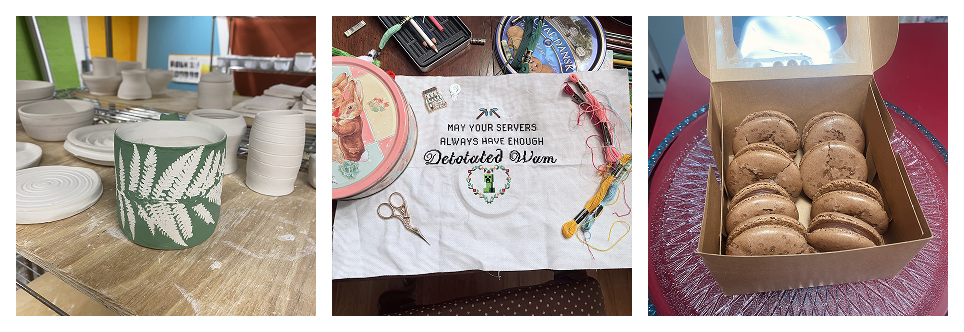
By grandma hobby, I mean something repetitive, quiet, and that keeps your hands busy while your mind stills. I took up cross-stitch this year and I love it. I sit on the couch, record spinning on the turntable, and stab a piece of fabric over and over in a way that feels both meditative and slightly feral.
In December, I hosted a little craft night at my house: a neighbor, my best friend, and my mother-in-law. Three women who had never met, connected only by me and a pile of half-finished projects and the willingness to try something new. It was cozy and unremarkable and perfect. I want to do it again; let it grow, see who shows up.
Choose one analog ritual.
Something small but recurring. Maybe it’s morning coffee without your phone, or a weekly walk to the library. Writing letters instead of texts every now and again. A record you have to listen to from start to finish, rather than a playlist you can shuffle. Or, maybe, you take up film photography.8 These rituals absolutely won’t save you time—but they will give it shape.
Choose one thing to do slowly, on purpose.
Bake something from scratch. Walk without headphones. Finish something imperfect by hand and let it be enough.
You don’t have to live in a hole in the ground to Hobbitmaxx; it’s really about choosing to inhabit where you already are in place and time. Settle in, make it cozy and comfortable.
So in 2026 I’m choosing to make an effort, take my time, and inhabit my life. I’ll be walking, making, and generally just farting around on purpose. Hobbitmaxxing.
You’re welcome to join me.
Despite Kodak and Fujifilm’s best efforts at self-sabotage.
From his book A Year with Swollen Appendices. Coincidentally, written as part of his New Year’s resolution to keep a diary for the entirety of 1995.
I mean, the short answer (pun, ha) is that I am five-foot-nothing and grew up in a nerd household.
…walk, walk, walk, walk, walk.
(Additionally, this is the reason I say “attacked by twees” about once a week with no further context.)
Which I want to note, is not necessarily a virtue in the greater context of The Lord of the Rings.
Who am I? I’m supposed to be an introvert!
Casual Chey lore drop: this is because Muppet Treasure Island is one of my favorite movies.
Please do this.
Great post, I genuinely appreciate it. I will definitely be doing some hobbitmaxxing this year, I have just started today without noticing just by doing bird watching (grandpa hobby fr)
This is how I try to live my life!! Appreciating all the small marvels of the world , seeing the depth and history in everything. Feeling child like wonder and silliness. I love walking in alleys/twittens!!