

Beauty as a practice
Or: when to keep the moment, and when to let it keep you

I’ve been thinking a lot about beauty lately.
Not necessarily beauty as in fashion or style.1 Rather, the things and experiences in this world that are pleasurable to perceive.
I’ve been taking daily walks. In fact, the first draft of this was written while on one of those walks, quickly jotting half-formed musings into my notes app. Beauty has likely been on my mind for that reason2—as we’ve moved into a wet Kentucky winter, the scenery is bare and dismal. My eyes are a little starved for beautiful things, so I’m looking for them wherever I can. My phone is filled with snapshots that I’ve collected like a crow: moss on brick, or an interestingly gnarled tree trunk.
My brain operates in visuals and verse, so it’s easy for me to make daily life feel beautiful. I have the ability to romanticize any mundane experience: making tea, listening to a record, doing crafts.3 I will wax poetic about a neighbor’s interesting vergeboard or Victorian gravestone typography. It’s either enrich my enclosure, or go insane.
Because my brain is hunting for beauty in a less-than-beautiful season, I’ve been thinking of beauty in the abstract as well. Lately, it’s been about the words we use to describe the experience of witnessing a beautiful thing.
Awestruck. Overcome. Moved.
It feels like less of an idea, and more of a bodily event in many ways. It happens to you. You see a beautiful thing, and it can affect you physically: tears, silence, breath.4 The body reacts, then you decide what to do with that reaction.
That bodily hit is what makes us reach for a camera in the first place.
Through my camera, there is beauty that I want to keep—and there is beauty that I want to keep me instead.
Once-in-a-lifetime beauty
About a year ago, I got to watch the solar eclipse in totality. We (my partner, my in-laws, and I) traveled north to Bloomington, Indiana to try to catch the longest stretch of totality. The day was a slow creep toward something that felt inevitable: the sky dimming, air cooling, birds quieting, bats emerging. As the sun crescented,5 the light dappled down between the leaves and turned into sickles dancing on the ground. I had my camera pointed skyward for thirty minutes, waiting for the first moment of totality so I could capture it.


Eventually, the moon covered the sun, and I uncovered my lens. I focused. I clicked. I prayed that it turned out.
Ultimately, the picture wasn’t important. If I missed it, I missed it. But if I didn’t spend some of those four-minutes-and-two-seconds looking at the eclipse with my own eyes—well, that would be beauty wasted.
So I looked.
And I wept.
I did not expect to weep.
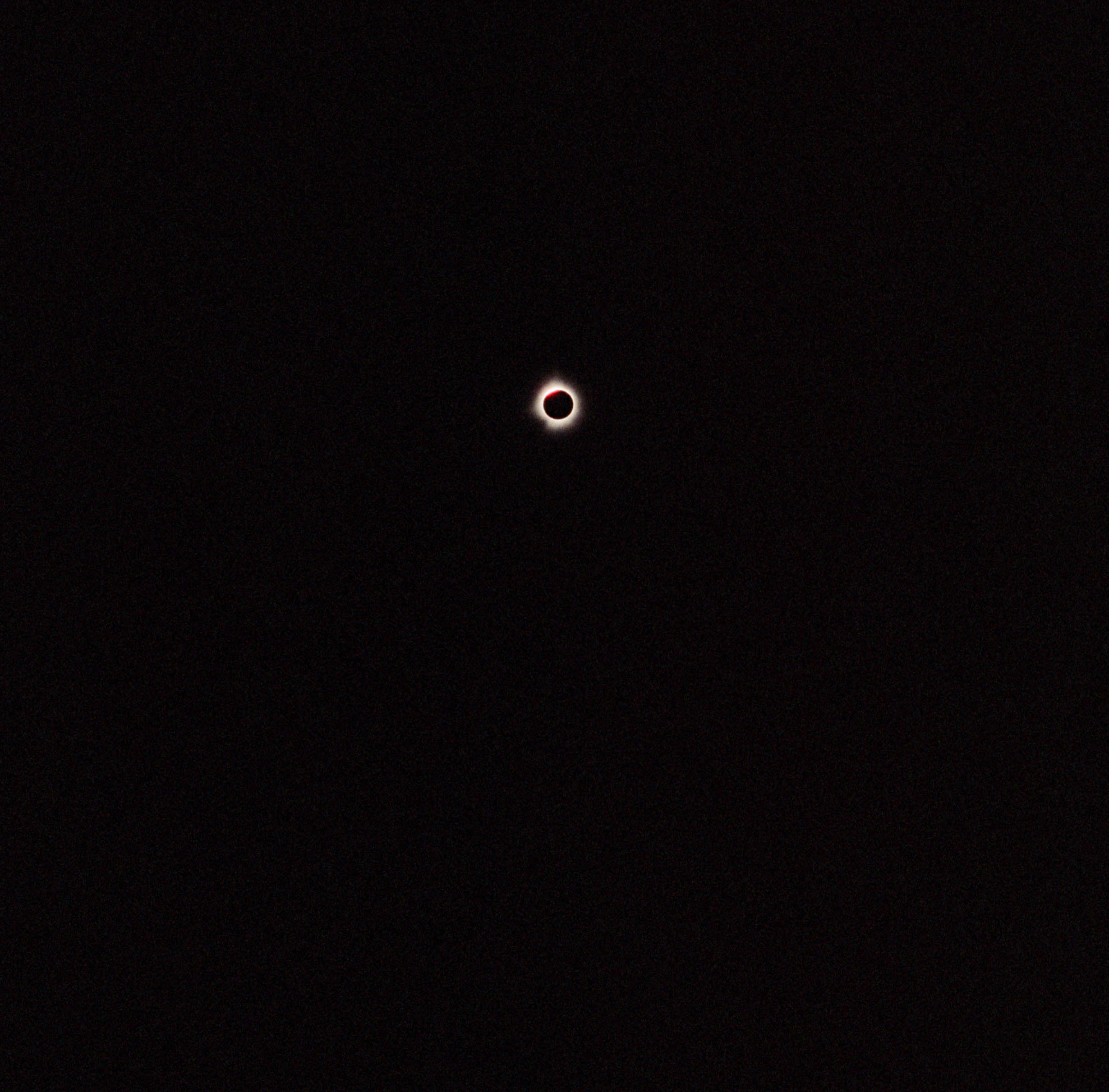
In my photo, the sun and moon look so tiny. It’s not a close-up photo, due to my choice of a medium format camera with a fixed lens. But looking at it… I remember more how the moment felt. I think I’d remember it even if I didn’t have the photo.
In the sky, the sun and moon felt huge. It was like it had taken up the whole sky—it hadn’t, of course, but even in the moment (not just in memory) everything felt… massive. We were in a public park, so there were gasps and shouts all around us. I stood silent, hand over mouth, staring upward with an occasional glance to watch the wonder on my partner’s face, too. In a funny way, this is the same reaction I have on rollercoasters—silent exhilaration.
Then, a rush of feelings and thoughts.
The serendipity that we’re on this big rock, with a satellite and a star that are the perfect, precise distance from each other that the moon can just cover the sun; so for a few minutes, it’s safe to look. What are the chances that the stars and planets, literally, align in this way? What are the chances that life would form on this rock—growing in tides pulled by that moon and warmed by that sun—and then develop into societies that could appreciate this phenomenon? I felt briefly connected to the people who witnessed eclipses before us. How terrifying and beautiful it must have been for ancient humans to see the sun swallowed up.
Suddenly, I felt impossibly small in my body—aware of the scale of me compared to the Earth I was standing on, which is so large that its curves are imperceptible to us on the ground. And beyond our Earth, into the dark I was looking up at, how expansive that is—how we literally call it space because that’s what the vast majority of it is, and how it stretches on (as far as we know) for infinity. How frightening. How humbling.6
I was awestruck. Overcome. Moved. Tears flowed, but I was grinning.
The moment ended. It lived on in me, anyway.
Everyday beauty
As someone with chronic art-brain, I’ve always been moved by beauty. So I can’t quite explain how or what would have changed, but it feels like the eclipse marked a split in my time. A before and an after. Perhaps what changed is that I capital-N Notice things now; and I’ve learned that noticing starts in the body.
The other day, my partner and I had to take a backroad to return home. It was a road we’d never taken before, one winding through hills and farmland. It was late afternoon and the day had been misty; the sky was storm-gray but for a peek of sun, causing crepuscular rays to spill through the clouds. We turned a curve, and laid out in the valley was a field of grain rolling in the wind. Silver and gold.
I gasped. Then, breathed a “wow, look at the view,” knowing my partner loves a silvery sky the way I love a misty morning.
He slowed the car. “Do you want to take a picture?”
“No, just drive a little slower.”
We did—his hands careful on the wheel, so we could both watch the valley as we passed by. I rolled the window down (in a chilly 50°F drizzle, mind you) and leaned out for a better look, my chin resting on my arms folded atop the car door.
We passed the field. I rolled the window back up, hair and sleeves slightly soggy.
I didn’t take a picture. But I remember it vividly, and I still felt an ache—a bodily kind—to both respond to the beauty in an attempt to keep it, and to share the shape of it anyway.
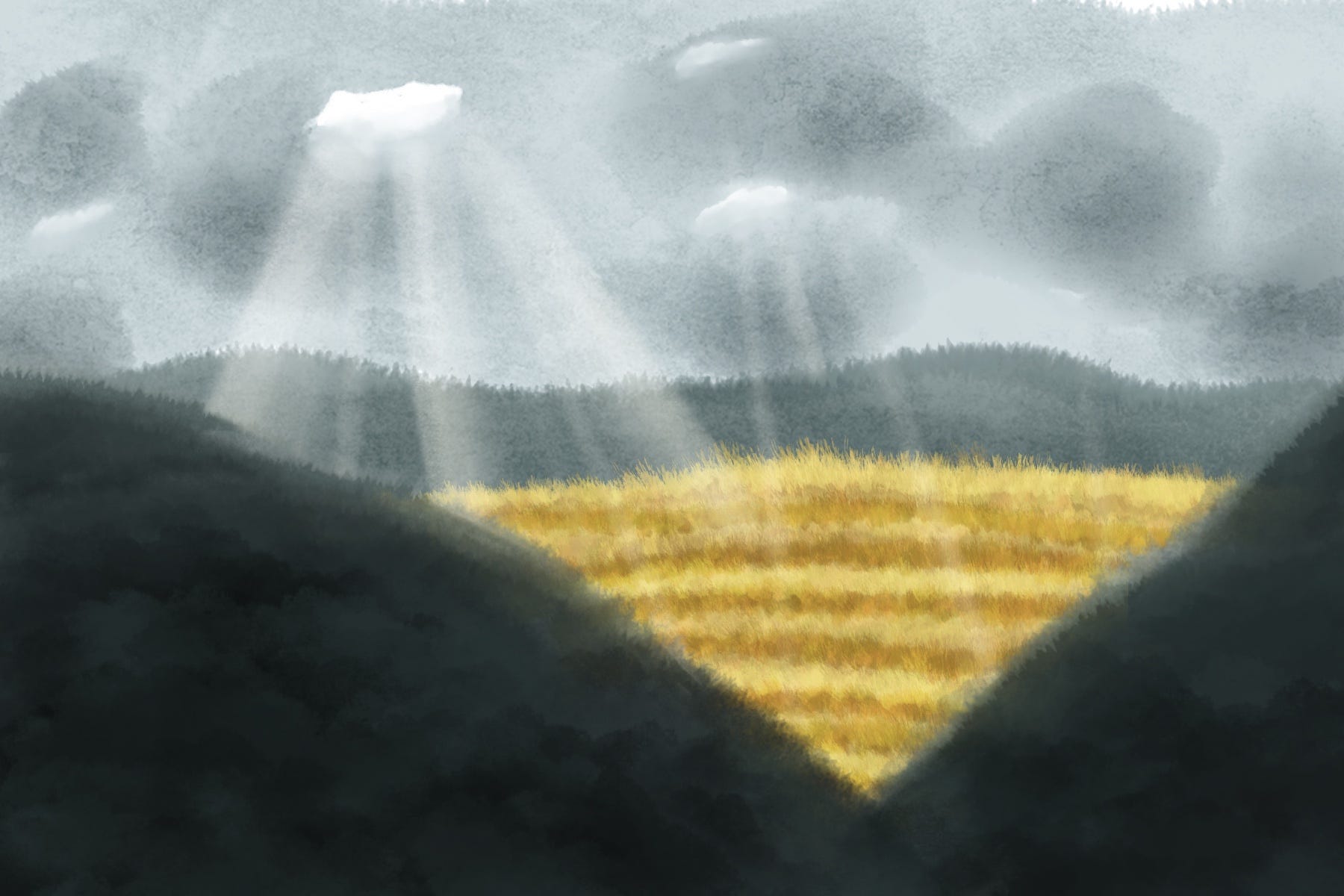
I do wish I had a photo of it, to see it properly again—but I know I will. Maybe not in a photograph, but on another drive, another valley, another cloudy day. And I know the feeling I get from seeing it in-person will be more satisfying than looking at a photo I took of it. I won’t ask my partner to stop next time, either—but we’ll still take the time to look and appreciate the moment.
Ephemeral beauty
Some say that beauty is fleeting. Statues erode, flowers wilt, bodies age.7 It can force a panic about transience and mortality. When taking a photo, you may be tempted to think “If I don’t capture it, I’ll lose it.” It’s older than photography, this fear that beauty leaves. In the body, that fear shows up as urgency rather than wonder.
I know I will age. My hair is already starting to salt-and-pepper; stark little white strands amongst the black. The corners of my eyes have wrinkles from smiling, with more on my forehead from how often I raise my eyebrows or look at things wide-eyed. But I like my gray hairs! They remind me of tinsel on a Christmas tree. And my face moves; it’s meant to. The wrinkles are simply proof that it’s expressive, often to my detriment. And I think that—evidence that you are living in your body—is beautiful in its own way.
On that note: my walks, recently, have been taking me through my local cemetery. A place built for remembering. It’s my little me-time, touch-grass hour. And, it’s where this concept of beauty became louder in my head.
The cemetery is pretty in the late summer. It’s pretty in the fall, too.
But I’ve found my favorite time there has been winter.
I walked there one November Monday, expecting a dreary trip. The leaves had all nearly fallen or were brown. But as I entered the gate, it began to snow. Just a few sprinkles.
Then as I strolled, the snow came down harder. Larger flakes. A light dusting across the ground and the graves around me.
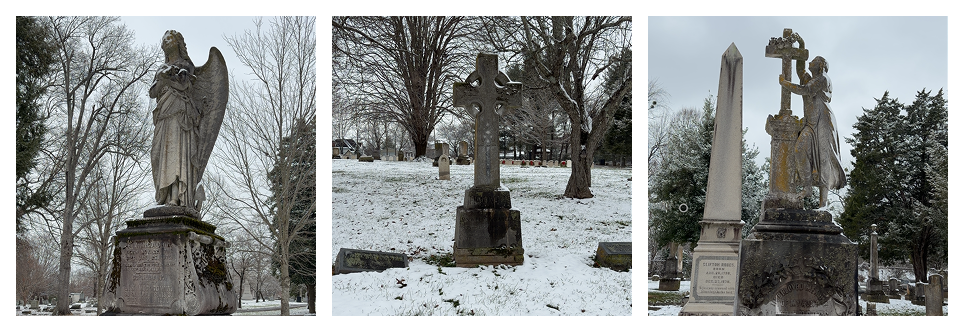
It continued like that until the flakes were huge, the size of my fingernails, and coming down in great fluffy piles. It stuck to the ground now, and covered the faces of angels with their eyes cast upward like they were considering sticking their tongues out to catch snowflakes. I was disappointed I didn’t have a camera with me.
I thought to myself… well, I suppose it’s time to go home. Yet I lingered. My nose was pink, snowflakes all over my hat and coat, but I was delighted. It was just me out there—I probably looked like a crazy lady, grinning to myself and walking in that weather. As I walked the path back, I did a twirl in my personal snow globe, my arms and coat flying outward—just because.
Because I could, because I was surprised by the snow, and because I was alive and aware of it from how cold my fingers were. Perhaps that level of joy was inappropriate for a cemetery.8 But it sort of welled up until it burst out of me—the beauty of the snow, the statues, the stillness. I considered returning that afternoon with a camera; but realized it would capture the snow, not the moment. So I told myself, enjoy this now. If it snows again this winter… I’ll come prepared, because I know exactly what I want to photograph.
Beauty as practice, camera as witness
Beauty isn’t always a thing—a possession. It’s just as often a practice of attention.
And photography sort of sits on that fault line of possession and presence, because it is both collecting and witnessing.
With the eclipse, I wanted the photo. But I didn’t want to watch it through the camera, I wanted to be there for it—and, in this rare instance, I got both. In the car driving by the farmland, I refused the camera, simply wanting to witness. And in the cemetery, I skipped the photo but kept the attention—with the understanding that it was a delay instead of a missed opportunity, and that yes, I could return to this (or a similar) moment with intention.
Sometimes the camera is a tool of attention (it helps you notice, it gives you a ritual, it proves you were there). Sometimes it’s a shield against transience (“If I don’t capture it, I’ll lose it,”) and suddenly you’re managing the moment, trying to preserve it instead of living it.
Ultimately, the camera isn’t the problem; rather, it’s what we do when our bodies tell us oh—pay attention.
So the question underneath isn’t “should I take photos?” Because the camera isn’t the only place you try to preserve rather than live (for example: posting on social media, or souvenirs). It’s just the most obvious.
Instead, it’s: when does keeping help you love something more, and when does keeping steal the thing you’re trying to love?
I don’t think there’s a set answer to that. I think it’s something mercurial—an answer you learn to know in your bones and in the moment, rather than in your head.
So, I want to end where I began—with the body. When was the last time you saw, heard, or read something that was so beautiful that it affected you in some physical way? When was the last time you had to decide: keep the moment, or let it keep you?
Although lately, dressing myself has been something I have been more intentional with and taken more delight in. A future newsletter, perhaps.

Unfortunately as a result, my brain cannot run numbers: so I do not have the ability to do math. (Joking. Mostly. Please do not ask me to do math.)
Further reading: this physical affect has a few names. Stendhal syndrome (Wikipedia entry), and frisson (Wikipedia entry), which is French for “shiver.”
And just for fun: here’s my playlist of every song (so far) that has given me cold chills.
My computer says that “crescented” is not a word. I say that I can verb any noun I like, thank-you-very-much.
I think about or reference Percy Bysshe Shelley’s “Ozymandias” probably a… weird amount. Usually when I’ve made something I’m proud of and I present it with a little flourish: “Look on my works, ye Mighty, and despair!”
I might be a bit of a drama queen.
Anyway. I feel this moment warrants a (re)read of the poem. The sands of time looked upon Ramesses II’s works, and were wholly unimpressed. You can read it at the Poetry Foundation.
Top-of-mind, because I recently gave myself a quarter-life crisis by reading Oscar Wilde’s The Picture of Dorian Gray while strolling my local graveyard. Whoops.
I’m someone who apologizes, by name, when I have to step onto a grave to get where I’m going. So, I felt pretty self-conscious immediately afterward—like I needed to dial it back because I was being too much. But I hope any lingering Victorian ghosts got a little kick out of it.